From Trash to Earth: What Really Happens to a Compostable Bag After You Toss It
The Future of Plastic Isn’t Plastic-Free. It’s Complicated.
Jun
For a long time, the conversation around plastic felt almost too simple.
Plastic was the problem. Using less of it was the solution. Governments announced bans. Brands launched sustainability campaigns. Consumers started carrying tote bags everywhere. And for a while it genuinely felt like the industry had figured out where it was headed.
Then the closer the world actually got to replacing plastic, the messier everything became.
Here we are in 2026 and manufacturers, governments, recyclers, environmental groups and businesses all agree on exactly one thing. Packaging needs to change. What it should change into, however, is a conversation that gets louder and more complicated by the year.
Welcome to the most interesting and honestly the most confusing era the packaging industry has ever been through.
Nobody is arguing about whether change is necessary anymore. They are arguing about which change.
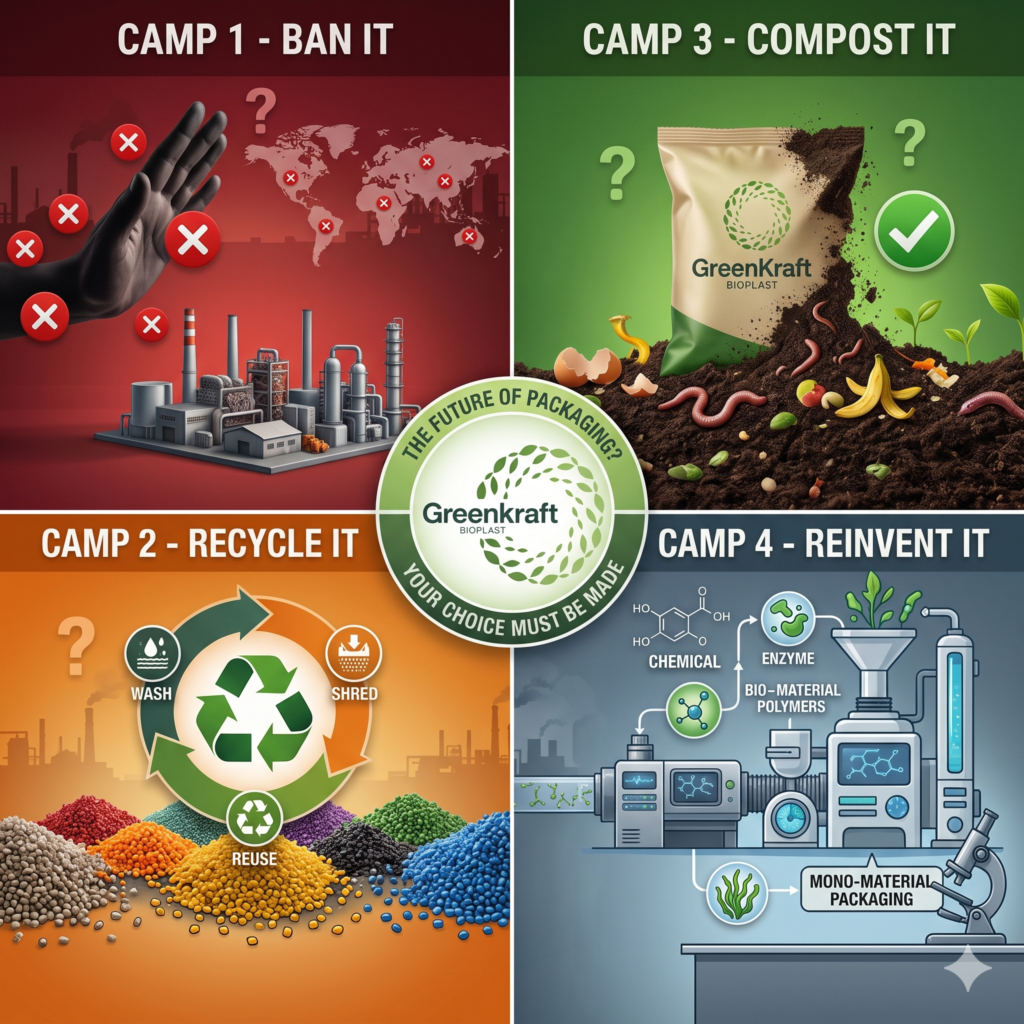
Should we ban plastic outright? Recycle more of it? Replace it with compostable alternatives? Or tear up the whole approach and start again? The answer shifts completely depending on who you ask and what problem they are most worried about. That is not a sign that nobody knows what they are doing. It is a sign that the problem is genuinely hard.
Here is where each camp stands right now.
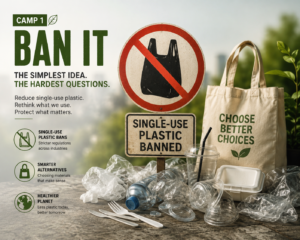
The Ban It Camp
The most visible position is also the most intuitive. If plastic creates problems, produce less of it. Governments around the world have introduced restrictions on single use plastics and tighter regulations on packaging waste. In India the 120 micron carry bag rule has already forced businesses to rethink their packaging choices in real and practical ways.
Compelling argument. But it runs into hard questions quickly. What replaces food packaging designed to prevent spoilage? What replaces industrial packaging that needs optical clarity to function? A significant portion of packaging exists specifically because people need to see through it. The product inside, the medicine dosage, the shipment contents. Most alternatives cannot deliver that transparency at a price that makes commercial sense. And cost matters more in this conversation than anyone admits. Plastic alternatives come at a significantly higher price per unit, and for businesses on tight margins that is a real barrier, not a footnote.
Removing plastic turns out to be considerably easier in theory than in practice.
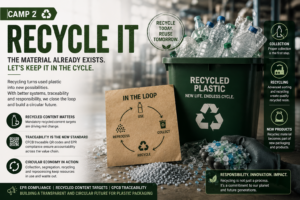
The Recycle It Camp
Another camp argues the problem was never plastic itself. The problem is what happens to it after we are done with it. This view has become increasingly influential as EPR compliance rules for plastic packaging tighten and mandatory recycled content targets stop being aspirational and start being mandatory.
Manufacturers are now being asked questions that did not used to come up. How much post-consumer recycled content is in your packaging? Can that content be traced? India’s evolving Extended Producer Responsibility framework and CPCB traceability systems are pushing businesses toward a future where recycled content is simply expected, not celebrated as a bonus.
The logic is straightforward. The material already exists. Why not keep using it?
The Compost It Camp
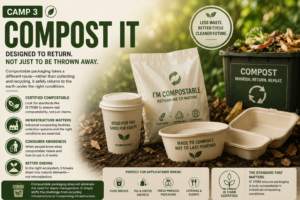
Then there is the compostable camp, which approaches the whole question differently. Rather than collecting and recycling packaging after use, why not design packaging that safely returns to the environment under the right conditions?
The certified compostable market has grown considerably in recent years. But this approach comes with its own honest complications. IS 17088 certification, industrial composting infrastructure, collection systems, consumer education about what compostable actually means in practice. A compostable bag only works as intended if the whole ecosystem around it works too. The material is one part of a much larger equation.
The Reinvent It Camp
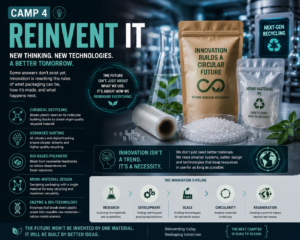
And then there are the people who think the final answer has not been invented yet. Chemical recycling versus mechanical recycling. Mono-material packaging design. Bio-based polymers. Enzyme recycling. Advanced sorting technology. Their argument is not that current materials are good or bad. Their argument is that current materials might simply not be the last word.
They might be right.
So what does this mean for your business right now?
The honest answer is that no single material strategy currently solves every problem. Recycling infrastructure is improving but collection, segregation and contamination remain real challenges. Compostable alternatives work brilliantly in the right applications and fall short in others. Virgin plastic still makes sense in contexts where performance, clarity and consistency are non-negotiable.
The future of packaging is probably not going to belong to one material. It is going to belong to the businesses that understand which material is right for which application and can make that decision with clarity rather than just chasing whichever label sounds best right now.
| Application | Material fit | Key driver in 2026 |
|---|---|---|
| Food delivery and QSR | Certified compostable | Food contamination limits conventional recycling |
| High volume retail | Recycled plastic | Cost efficiency and recycled content targets |
| Industrial and electronics | Virgin plastic | Strength, clarity, consistency, performance |
| Luxury retail and apparel | Mono-material or reusable | Branding and sustainability positioning |
Where GreenKraft Bioplast fits into all of this
We have this conversation with customers every week. Some want virgin plastic. Others want recycled content. Many are actively exploring certified compostable options and trying to understand what that actually means for their specific use case.
We manufacture virgin and recycled plastic packaging and we are working through CPCB certification for our compostable range because we think getting that process right matters more than getting it done fast. We also offer 6 colour ceramic plate flexographic printing for businesses that want their packaging to carry their brand as sharply as it carries their product.
What we have learned from being in the middle of this debate is simple. There is no universal answer. The right material depends on the application. And the businesses that will navigate the next few years well are the ones having honest conversations about that rather than looking for a single solution to a problem that does not have one.
The future is not plastic-free. It is more complicated than that.
After decades of debate, the world has still not decided what should replace plastic. And maybe that is because there is not one replacement.
Maybe the future of packaging is not about picking a side. Maybe it is about understanding that different problems genuinely require different solutions and building the knowledge and supply chain to act on that understanding.
The packaging industry in 2026 is not searching for a winner.
It is searching for balance.
And that conversation has only just begun.
FAQ
Extended Producer Responsibility is a framework that holds manufacturers and brands accountable for the end of life management of the packaging they put into the market. In India the EPR framework for plastic packaging is becoming increasingly enforceable, meaning businesses need to be actively thinking about recycled content, take-back systems and packaging design rather than treating it as someone else’s problem.
It depends entirely on the application and what end of life pathway is available. Compostable packaging in a context where industrial composting infrastructure exists and consumers know how to use it correctly is genuinely better for certain applications. In a context where it ends up in a landfill or a regular waste stream, it offers little real advantage. Recycled plastic, by contrast, works within existing waste systems and gives material another round of usefulness without requiring new infrastructure.
It means that plastic carry bags must meet a minimum thickness of 120 microns, making them more durable and theoretically more reusable. Thinner, cheaper bags that were designed to be used once and discarded are no longer legal. For businesses this means working with manufacturers who meet the specification and can demonstrate compliance.
For most applications, yes. Recycled content packaging performs comparably to virgin material for everyday use, costs less, and positions your business ahead of recycled content mandates that are only going to become more stringent. The time to start building that into your supply chain is before it becomes a compliance requirement rather than after.
Ask for specifics. What certifications do they hold or are actively working toward? What percentage of recycled content is in the material and can that be traced? Are eco claims backed by third party verification? A manufacturer who can answer these questions clearly and without hesitation is one worth taking seriously.