
From Trash to Earth: What Really Happens to a Compostable Bag After You Toss It
Compostable vs Biodegradable vs Oxo Biodegradable Bags: What Is the Difference in India?
Nov
Imagine you are sourcing bags for your business. Three suppliers send you quotes. One says biodegradable. One says compostable. One says oxo biodegradable. The prices are close, the pitch sounds the same, and nobody explains the difference.
Here is the problem. These words are not interchangeable. They describe different ways plastic breaks down, and in India they come with very different rules. Mixing them up can get expensive.
Let us sort it out.
Biodegradable: the label with a missing certificate
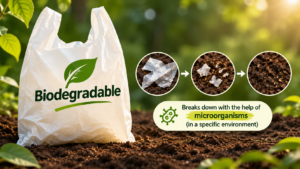
Biodegradable plastic is meant to be broken down by microorganisms. But the word alone does not tell you how long it takes, where it happens, or whether anyone tested it.
In India, biodegradable carry bags need CPCB certification before they can be sold, and they must meet IS 17899 T:2022, an interim standard. The label must also state the number of days and the environment.
Here is the catch. In September this year, CPCB clarified that as of 23 July 2026, 371 manufacturers were certified for compostable plastic products. For biodegradable carry bags and commodities, the number was zero.
So if a bag calls itself biodegradable, ask for the CPCB certificate. By CPCB’s own records, there is not one to show.
Compostable: it has to do more than crumble
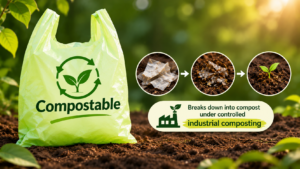
Compostable plastic is designed to break down under controlled composting conditions and become part of the compost itself. In India it must meet IS/ISO 17088:2021, which checks that the material disintegrates, truly biodegrades, produces compost that is safe for plants and soil, and meets material safety requirements.
That is why a bag is not compostable just because it contains starch or says plant based on the front.
And here is the biggest misunderstanding. Compostable does not mean you can toss it in your garden compost. Industrial facilities control temperature, moisture and oxygen in a way a backyard pile cannot. That is why Indian rules require the label to say “Compostable only under industrial composting.”
Oxo biodegradable: the one that fools people
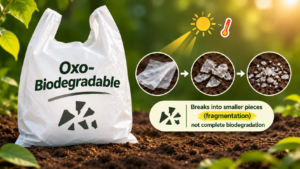
Oxo biodegradable plastics are ordinary plastics with additives that speed up oxidation when exposed to heat, oxygen and sunlight. The plastic turns brittle and breaks into smaller and smaller pieces.
It looks like the bag is disappearing. It is not.
Think of dropping a ceramic plate. It shatters into a hundred pieces, but nobody would say the plate has biodegraded. Fragmentation is not the same as microorganisms converting a material into natural end products. Oxo biodegradable plastic should never be confused with compostable plastic certified under IS/ISO 17088:2021.
The quick comparison
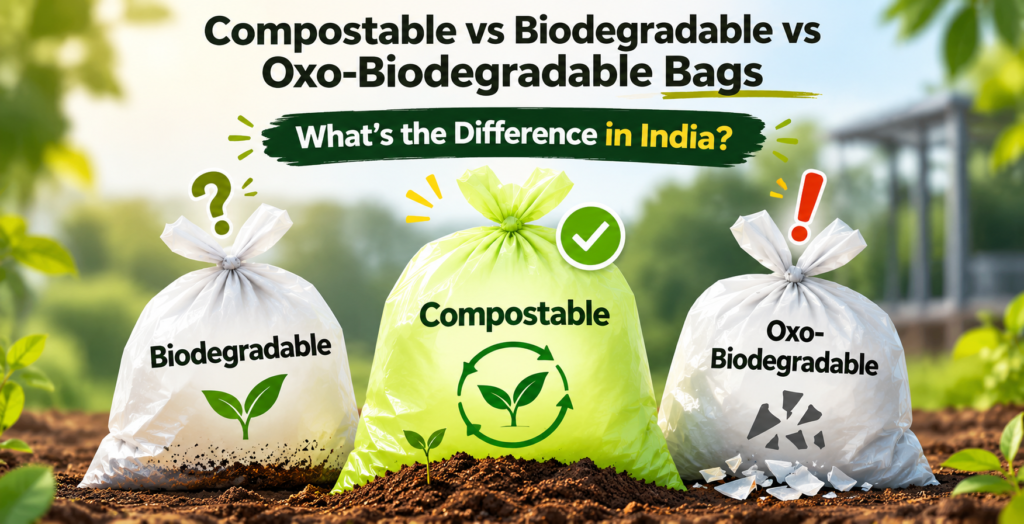
| Biodegradable | Compostable | Oxo biodegradable | |
|---|---|---|---|
| How it breaks down | Biological activity | Biological activity during composting | Oxidation, then fragmentation |
| Indian standard | IS 17899 T:2022 (tentative) | IS/ISO 17088:2021 | None that proves compostability |
| Home compostable? | Not automatically | Not automatically | No |
| CPCB certification | Required (none issued as of July 2026) | Required | Cannot be sold as certified compostable on this basis |
What should you check before buying?
Do not trust the word printed on the bag. Ask for the CPCB certificate number and check that the company name and address match. Confirm that the certificate covers your exact product. Ask for test reports and look for the mandatory labelling. And ask one last question: where will this packaging actually be composted after use?
International marks like EN 13432 and ASTM D6400 are useful supporting evidence, but they do not replace CPCB certification in India. Rules also change, so always check the latest CPCB updates before you buy or market anything.
Where GreenKraft Bioplast stands
We manufacture virgin and recycled plastic packaging from Sachin GIDC, Surat. Our compostable range is going through CPCB certification, and we will not sell it as compostable until that certificate is in our hands.
After reading the numbers above, you can probably see why.
A responsible packaging choice is about more than what is printed on the bag. It is about what the material actually does once you are done with it.
FAQ
No. Compostable plastic is tested for breakdown under controlled composting conditions and must meet IS/ISO 17088:2021. Biodegradable plastic follows a separate standard and certification route, and the word alone says very little about time, place or residue.
Not automatically. Indian rules require compostable plastic to be labelled as compostable only under industrial composting, because home piles rarely reach the conditions needed.
They fragment into smaller pieces, but fragmentation does not prove biodegradation. They are not a substitute for certified compostable plastic.
Only with CPCB certification. As of CPCB’s July 2026 records, no manufacturer of biodegradable carry bags or commodities had been certified, so be very cautious about any supplier making that claim.
Not yet. Our compostable range is going through CPCB certification, and we will launch it only once the certificate is issued. Until then we manufacture virgin and recycled plastic packaging.