
From Trash to Earth: What Really Happens to a Compostable Bag After You Toss It
How Many Times Can Plastic Actually Be Recycled?
Sep
We hear constantly that plastic is recyclable. It is on packaging, in government campaigns, in sustainability reports from brands trying to show they care.
But here is the question that almost never gets asked.
How many times can the same piece of plastic actually go through the recycling process before it is no longer useful?
Once? Five times? Indefinitely?
The honest answer is that there is no single number. And the reason why is actually more interesting than the number itself.
What recycling actually does to plastic
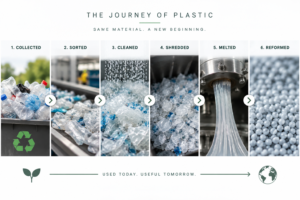
When plastic goes through mechanical recycling, it gets collected, sorted, cleaned, shredded, melted down and reformed into new material. Straightforward enough on the surface.
But during that process, particularly when the plastic is exposed to heat and mechanical stress, something happens at a molecular level. The long chains of molecules that give plastic its useful properties, its strength, its flexibility, its ability to stretch without snapping, can start to break down into shorter chains. Scientists call this chain scission.
Think of it like a long piece of thread. New and strong, it holds together well. Put it through stress repeatedly and parts of it start to weaken or break. The thread does not disappear. But it behaves differently.
Plastic does not become useless after one recycling cycle. But repeated processing does change how it behaves.
Does it get worse every time?
Not in a neat, predictable way. This is one of the biggest misconceptions about recycling.
There is no simple rule that says cycle one is perfect, cycle two is slightly worse, cycle five is noticeably degraded and cycle ten is unusable. Different types of plastic behave differently. Even the same plastic can behave differently depending on how clean it is, what processing conditions it went through, and what contaminants or additives were mixed in with it.
In controlled lab conditions with clean material, plastic can actually hold up surprisingly well across multiple cycles. The problem is that real world plastic waste is rarely perfectly clean or consistent. It comes mixed with contamination, different polymer types, residues, and additives that all affect how the recycled material performs.
So the more useful question is not how many times can this be recycled. It is how many useful lives can we get from this particular material before it is no longer suited to any application.
Downcycling is not failure
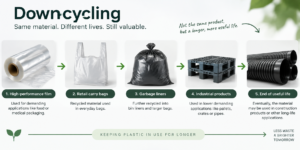
Sometimes recycled plastic no longer meets the requirements of its original application. That does not make it waste. It might be perfectly suited to something else that has different performance requirements.
This is called downcycling. Moving a material from a more demanding application to one where it can still do a good job. It is not ideal in a perfect circular economy but it is far better than the alternative, which is the material going nowhere useful at all.
Keeping material in circulation through different applications and different lifecycles is genuinely valuable, even if it is not the same loop every time.
One thing that needs to be very clear
When scientists talk about polymer degradation during recycling, they mean changes to the material caused by processing. They do not mean the plastic has broken down in the environment.
A plastic film becoming weaker after repeated processing is not the same thing as that plastic biodegrading in soil or water. The two are completely unrelated. Degraded inside a machine does not mean decomposed in nature. These terms are not interchangeable and treating them as though they are leads to a lot of confusion and some genuinely misleading claims.
What about chemical recycling?
Mechanical recycling reprocesses the plastic material itself. Chemical recycling works differently. It breaks certain plastics down into smaller molecules, sometimes close to their original building blocks, which can potentially be used to make new plastic again.
In theory this sounds like a reset button. In practice it requires significant energy, faces real challenges around contamination and sorting, and is still developing at scale. Neither mechanical nor chemical recycling is simply the good version or the bad version. They address different problems and different material types.
The question worth asking
At GreenKraft Bioplast we think about this constantly. Recycled cannot just be a label. The material still needs to perform for its application, whether that is a carry bag, a garbage liner, a shrink film, or anything else. Recycled resin varies. What it can do depends on where it came from, how it was processed, and what it is being asked to do next.
The goal is not to make one piece of plastic travel through the exact same loop forever. The goal is to give it as many useful lives as reasonably possible.
That shifts the question from is this plastic recyclable to something more interesting.
What can this plastic become next?
FAQ
There is no fixed number that applies to all plastics. It depends on the type of polymer, how clean it is, what processing conditions it goes through, and what it needs to do afterwards. Some plastics hold up well across multiple cycles in controlled conditions. Real world recycling is messier and the performance of recycled material reflects that.
For many everyday packaging applications, yes. For applications requiring very specific properties like high optical clarity, precise mechanical performance, or consistent barrier properties, virgin material may still be the more reliable choice. The right answer depends on what the packaging needs to do.
Completely different things. Degraded plastic has undergone changes to its molecular structure during processing. It has not broken down in the environment. Biodegradable plastic is specifically designed to decompose under natural or controlled conditions. A recycled plastic bag that has been through multiple processing cycles is not biodegradable simply because it has been processed multiple times.
Downcycling is when a material moves from a more demanding application to one with lower performance requirements after recycling. It is not ideal but it is far better than the material becoming waste. Keeping plastic in useful circulation across different applications extends its overall value even if it is not going back to exactly where it started.
Not automatically. The right material depends on the application, the required performance, and what happens to the packaging afterwards. Recycled material is genuinely better for many everyday packaging uses. For applications where performance cannot be compromised, a conversation about the specific requirements is more useful than a blanket rule.