
From Trash to Earth: What Really Happens to a Compostable Bag After You Toss It
Micron, Gauge and GSM: What Is The Difference and Why Does It Matter?
Sep
Here is something that happens more often than you would think in the packaging industry.
A buyer calls a manufacturer and says “I need 120.” The manufacturer starts asking questions. 120 micron? 120 gauge? 120 GSM? The buyer pauses. They assumed everyone would just know what they meant.
They did not. And that assumption, small as it seems, can result in packaging that is completely different from what was intended.
So let us sort this out once and for all in plain language.
Three words. Three different things.
Micron and gauge both tell you how thick the film is. GSM tells you how much it weighs. That is the short version. Everything else is just detail.
| Measurement | What it tells you |
|---|---|
| Micron | Thickness of the film |
| Gauge | Thickness of the film, different scale |
| GSM | Weight of one square metre of material |
Micron: the one most people in India use
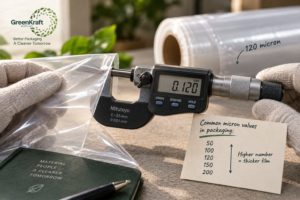
A micron is simply a unit of thickness. One micron is one thousandth of a millimetre, which gives you a sense of just how thin plastic film actually is.
When someone says this is a 120 micron bag, they mean the film is 0.12 millimetres thick. That is roughly the width of a human hair, sometimes thinner. And yet it is carrying your groceries home.
Common micron values you will come across in packaging are 50, 100, 120, 150, and 200. The higher the number, the thicker the film. In India, carry bags are legally required to be a minimum of 120 microns under current regulations.
Gauge: micron’s distant cousin
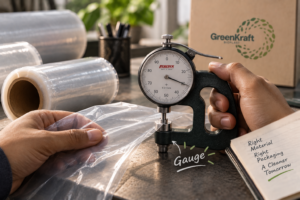
Gauge also describes thickness. Same family, different measuring scale.
The conversion is straightforward. One gauge equals 0.254 microns. If you want a quick estimate rather than the exact number, just divide the gauge by four and you will be close enough for most practical purposes.
So 400 gauge divided by four gives you approximately 100 micron. 200 gauge gives you roughly 50 micron. 120 gauge gives you around 30 micron.
This is why 400 gauge and 400 micron are very different things. A 400 gauge film is about 100 microns thick. A 400 micron film is four times that. Same number, completely different reality.
Micron and gauge are distant cousins. Both belong to the thickness family and you can convert between them directly. Just remember the scale is different.
GSM: the one that confuses everyone
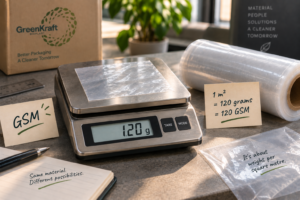
GSM stands for grams per square metre. It tells you how much one square metre of the material weighs, not how thick it is.
This is where people get tripped up. A higher GSM does not automatically mean a thicker film. It means a heavier one. And weight and thickness are not the same thing because different materials have different densities.
To convert GSM to micron you need to know what the material is made of. The formula is micron equals GSM divided by density, where density is measured in grams per cubic centimetre. For polyethylene, which is what most flexible plastic packaging is made from, the density is approximately 0.92.
So 100 GSM of polyethylene film works out to roughly 109 microns. But 100 GSM of a different material with a density of 1.39 would give you only about 72 microns. Same GSM. Very different thickness. This is why GSM alone does not tell the whole story without knowing what material you are dealing with.
The “120” problem, solved
Let us put all three together using the same number so the difference is impossible to miss.
120 micron means the film is 0.12 millimetres thick.
120 gauge, when converted, is approximately 30.5 microns thick. Much thinner.
120 GSM means one square metre of the material weighs 120 grams. Using polyethylene density that works out to roughly 130 microns thick.
Three instances of the number 120. Three completely different specifications. This is exactly why asking “120 what?” is not a silly question. It is the only sensible one.
Thickness is not the whole story either
One more thing worth knowing. Thicker does not automatically mean stronger or better. Two films with identical micron measurements can behave very differently depending on the material, the formulation, the proportion of recycled content, and how the film was made.
The right question is rarely just how thick should this be. The more useful question is what does this packaging actually need to do? The specification follows the answer, not the other way around.
At GreenKraft Bioplast this is the kind of conversation we have with clients regularly. Getting the basics right before an order is placed saves a lot of confusion afterwards. Because in packaging a number is only useful when everyone in the room agrees on what that number actually means.
Quick Cheat Sheet: Conversion Formulas
| What you want to find | Formula | Example |
|---|---|---|
| Micron from gauge (exact) | Gauge × 0.254 | 400 gauge × 0.254 = 101.6 micron |
| Micron from gauge (quick) | Gauge ÷ 4 | 400 gauge ÷ 4 = 100 micron |
| Gauge from micron (exact) | Micron ÷ 0.254 | 100 micron ÷ 0.254 = 394 gauge |
| Gauge from micron (quick) | Micron × 4 | 100 micron × 4 = 400 gauge |
| Micron from GSM | GSM ÷ Density | 100 GSM ÷ 0.92 = 109 micron (polyethylene) |
| GSM from micron | Micron × Density | 100 micron × 0.92 = 92 GSM (polyethylene) |
Common material densities for reference:
| Material | Approximate density |
|---|---|
| Polyethylene (LDPE / LLDPE) | 0.91 to 0.93 g/cm³ |
| Polyethylene (HDPE) | 0.94 to 0.97 g/cm³ |
| Polypropylene (PP) | 0.90 to 0.91 g/cm³ |
| PET | 1.38 to 1.40 g/cm³ |
The one rule to remember:
Micron and gauge are cousins. Divide or multiply by four and you are close enough for most practical purposes. GSM needs the material density before it can be converted to thickness. Without that, the number alone does not tell you enough.
FAQ
It depends on where they learned the trade and which markets they work in. Gauge is more commonly used in certain older manufacturing traditions and in some export contexts. Micron is more widely used in India for everyday domestic packaging. Both describe thickness so neither is wrong, they just need to be converted when comparing specifications across suppliers.
Not necessarily. Thickness is one factor in packaging performance but the material, formulation and manufacturing process all matter too. A well-made 120 micron bag from quality material can outperform a poorly made 150 micron bag. Always ask about the material alongside the micron specification.
Under the Plastic Waste Management Rules in India, carry bags must be a minimum of 120 microns. Bags below this thickness are not legally permitted for manufacture or sale. This regulation was introduced to encourage reuse and discourage very thin single use bags.
GSM is more commonly used for paper, non-woven fabrics, and certain speciality films where weight is a more meaningful specification than thickness. For standard flexible plastic packaging like carry bags or garbage bags, micron is almost always the more relevant measurement.
Quite a bit, actually. The material type, the bag dimensions, handle style if applicable, gusset requirements, seal type, quantity, and intended use all need to be clear before manufacturing begins. Micron is one part of a full specification, not the whole thing. A good supplier will ask all of these questions before confirming an order.