
From Trash to Earth: What Really Happens to a Compostable Bag After You Toss It
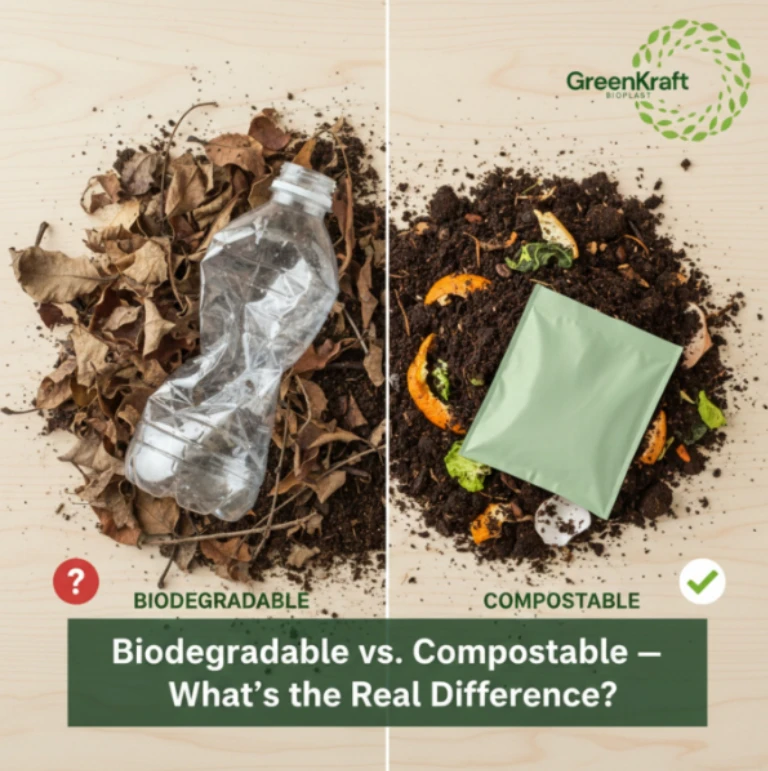
Biodegradable vs. Compostable: Why These Two ‘Green’ Terms Aren’t the Same
Jan
Finally, a clear, no-greenwashing guide to understanding the difference between biodegradable and compostable materials. Learn what the certifications mean, why confusion exists, and how to identify truly eco-friendly packaging.
Introduction: When ‘Green’ Gets Confusing
“Biodegradable”, “compostable”, “eco-friendly” — these terms are everywhere. From plastic carry bags to food packaging, every label seems to claim some version of “planet- friendly.” But here’s the problem: not all “green” words mean the same thing. The confusion between biodegradable vs compostable isn’t just a technical one — it affects how we consume, dispose, and trust sustainable products. At Greenkraft Bioplast, we believe it’s time to cut through the noise and explain these terms clearly — so you can make informed, responsible choices that actually reduce waste.
The Root of Confusion: Marketing vs. Reality
The biggest reason behind the mix-up? Lack of global standardization and misleading marketing.
Some manufacturers use biodegradable and compostable interchangeably, but the reality is — they break down under completely different conditions. Without clear labeling or global definitions, consumers often assume all biodegradable materials are automatically safe for the planet. Unfortunately, that’s not always the case.
This grey area has led to consumer confusion, greenwashing, and misinformed decisions, where products marketed as “eco” may still leave microplastic residue or take decades to degrade.
What Does Biodegradable Really Mean?
In simple terms, biodegradable materials are those that can be broken down by microorganisms (like bacteria or fungi) into water, carbon dioxide, and biomass. Sounds good, right? But here’s the catch — there’s no fixed time frame for how long this process takes. Some biodegradable plastics may break down within months under ideal conditions, but can take years — or may not degrade at all — in landfills or the ocean, where oxygen and microbes are limited. Even worse, some biodegradable plastics only fragment into smaller pieces instead of fully decomposing — leading to microplastics, which still pollute soil and oceans.
So while biodegradable sounds appealing, it doesn’t guarantee a harmless end product or full mineralization.
Does “Biodegradable” Guarantee a Harmless End Product?
Not necessarily.
Many biodegradable materials still require specific industrial conditions to break down completely. In the absence of such environments (like open landfills or oceans), they may only partially degrade, releasing microplastics or methane gas — both harmful to the environment.
What Does Compostable Mean?
Compostable materials, on the other hand, are designed to break down within a defined time frame — usually 90 to 180 days — under industrial composting conditions (controlled temperature, humidity, and microorganisms). When done right, they leave no toxic residue, converting into CO₂, water, and nutrient-rich biomass — perfect for enriching soil.
However, not all compostable materials work in home compost setups. Some require industrial composting facilities to maintain the necessary heat and microbial activity.
What Specific Conditions are Required for Compostable Materials to Break Down?
Compostable packaging typically needs:
1. High heat (around 55–60°C)
2. Controlled moisture levels
3. Aeration and microbial presence
Without these, even compostable plastics can remain intact for years. That’s why proper disposal infrastructure is crucial for realizing their full environmental benefit.
What is the Key Difference Between Biodegradable and Compostable?
Here’s the simplest way to put it:
| Aspect | Biodegradable | Compostable |
| Decomposition Time | Variable (weeks to decades) | Defined (usually 90–180 days) |
| End Product | May leave microplastics | Converts fully to CO₂, water, and biomass |
| Conditions Required | Natural or artificial | Requires specific composting setup |
| Certifications | Rarely standardized | Certified under standards like ASTM D6400 or EN 13432 |
| Environmental Impact | Can vary widely | Predictably low if processed correctly |
Both can be eco-friendly — but only if used and disposed of correctly.
What Certifications Prove a Material is Truly Compostable?
Look for recognized standards like:
- ASTM D6400 (U.S.)
- EN 13432 (Europe)
- ISO 17088 (International)
These ensure that the material fully breaks down within the set time frame and leaves no harmful residue.
Where Each Works Best
Compostable materials work best for single-use food packaging, mulch films, and carry bags, which can go directly into composting systems
Biodegradable materials are more suitable for durable goods like cutlery, bags, and films designed for long-term use — as long as they’re collected and processed responsibly.
Choosing the right material for the right application is what creates true circularity.
The Challenge with Labels: Spotting Greenwashing
A lot of “eco-friendly” packaging today is simply greenwashing — making sustainability claims that sound good but aren’t backed by facts.
Here’s how to spot genuine products:
- Look for clear certifications (ASTM D6400, EN 13432, ISO 17088)
- Avoid vague labels like “100% biodegradable” without a time frame
- Check for material transparency and disposal instructions
If a company doesn’t disclose how its products break down — it’s a red flag.
Conclusion: The Real Choice Lies in Awareness
Both biodegradable and compostable materials have their place in sustainable packaging — but the difference lies in how they’re used and disposed of.
The next time you see a “green” label, look beyond the buzzwords. Ask: Is it certified? Is it truly compostable or just biodegradable?
At Greenkraft Bioplast, we focus on certified compostable packaging in India — developed through sustainable R&D to ensure genuine environmental benefit.
Because being green isn’t about the label — it’s about the lifecycle.
Not always. Compostable bags are biodegradable, but not all biodegradable bags are compostable. Compostable bags meet strict certification standards for complete, safe decomposition.
Most biodegradable plastics need industrial conditions. Unless labeled “home compostable,” they won’t break down efficiently in backyard compost bins.
Check for certifications like ASTM D6400, EN 13432, or OK Compost. These indicate verified compostability under specific conditions.
Neither is universally “better.” It depends on the application, infrastructure, and disposal. Compostable materials are ideal for food-related waste; biodegradable ones suit longer-use products.